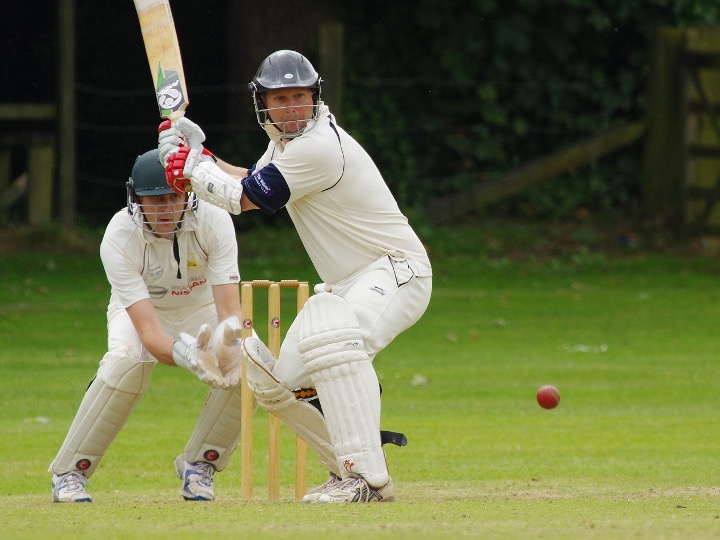
Keep your Eye on the Ball. It Sounds Good but Can You Do It?
Don Bradman advised young cricketers to ‘keep their eye on the ball.’ And a long line of cricketing giants such as Geoff Boycott, Matthew Hayden and Justin Langer have also said it.
But there’s a problem.
The Don couldn’t do it. And neither could Boycott, Hayden and Langer.
The Problem is Your Eyes Can’t Keep Up
Your eyes simply can’t track a cricket ball at the speed they’re usually thrown.
But there’s another problem. You need to hit the ball. To do that, there are a few more things you need to do. You need to decide what sort of shot you’re going to hit. You then need to get into position and organise your swing.
And to do all this, your mind has to send a message to your muscles via your spinal cord which takes around 200 milliseconds (1/5 of a second).
You Need To Know Where the Ball Will Be, Before It Gets There
But you can’t wait until the ball actually arrives and then decide what you’re going to do. It’s all too late. Somehow you need to know where the ball is going to end up before it even gets there. If you wait by following the ball ‘right onto your bat’ and then get organised to hit it, the ball will be long gone.
But a skilled batsman doesn’t have a problem. Despite not being able to track the ball, somehow they can comfortably deal with balls coming at them at speeds of 140kmph or more. And uncannily they don’t seem to be rushed. They’re always in position and ready to make the shot. For them the ball seems to travel in slow motion.
A Quirky Visual Dance
What Bradman and company didn’t know is our eyes take us on a surprising and quirky visual dance. This dance allows us to collect enough information so we know where the ball is going to end up before it gets there. In this way, a skilled batter is well prepared for the ball’s arrival.
But what makes things a little complicated is in cricket the ball usually bounces before it can be hit. However, the visual dance of our eyes automatically changes its dance steps to take care of it. So there’s an incredible lot going on.
Bradman was in the Dark But You Don’t Have to Be
However, Bradman and company weren’t aware of any of this. That’s because it all takes place in our subconscious. Its job is to collect information, make sense of it and issue the appropriate orders to our muscles to swing into action. And it’s all hidden from our conscious mind.
So despite the endorsement of cricketing heavyweights, ‘keeping your eye on the ball’ is nothing more than a bit of homespun philosophizing. And just plain wrong at that.
You Need Answers To Three Major Questions
You’ve already got some answers to some fundamental questions. But there are still a few things you need to know if you want to be a good cricketer. You need to know:
- What exactly are our eyes doing to cope with the various types of bowling?
- If everything is happening at a subconscious level, how do we train our subconscious to do a better job? And indeed, is it even possible? And
- What should we be telling ourselves, let alone our young cricketers, about watching the ball and what to do instead?
So if you’re up for it, the answers to these and more can be found in my e-book:
How did Bradman get it so Wrong: Keep yourEye on the Ball – Good Advice or Nonsense.
It’s packed with information. Better still, it’s easy to read, easy to understand and easy to put into practice.
Check it out by clicking here.
All the very best.
Roger Wheller.